

Sim Lim Square store management: 5 strategies for success
Sim Lim Square draws thousands of shoppers every week, all hunting for the best deals on laptops, cameras, and components. With over 500 shops packed across six floors, the mall is Singapore’s most recognized tech retail hub. But a small fraction of errant stores has repeatedly damaged the reputation that every honest retailer depends on. The good news is that smart, customer-focused management can set your shop apart from the noise. This guide walks you through the exact strategies, from preparation to daily execution to crisis recovery, that help Sim Lim Square store owners build lasting trust and consistent sales.
Table of Contents
- Understanding the Sim Lim Square retail environment
- Planning for successful operations: Preparation and essentials
- Execution: In-store strategies for building trust and sales
- Verification and continuous improvement: Monitoring, reviews, and crisis handling
- Why Sim Lim Square’s reputation is everyone’s problem (and hidden opportunity)
- Take your Sim Lim Square store to the next level
- Frequently asked questions
Key Takeaways
| Point | Details |
|---|---|
| Reputation is vital | A small number of errant shops affect everyone, so store trust-building is non-negotiable. |
| Preparation matters | Proper groundwork—inventory, pricing, and staff—sets the stage for sustained success. |
| Transparency wins | Clear pricing, ethical bargaining, and open communication beat pressure sales tactics. |
| Continuous improvement | Regularly monitor KPIs, handle complaints proactively, and learn from both successes and mistakes. |
Understanding the Sim Lim Square retail environment
Sim Lim Square is unlike any other retail destination in Singapore. It is dense, competitive, and driven almost entirely by price perception. Understanding the environment you operate in is the first step to managing it well.
The mall hosts more than 500 individual shops, yet the 2% errant retailers who engage in overcharging, bait-and-switch tactics, or selling pirated goods have triggered police raids, CASE advisories, and waves of negative press. That damage does not stay contained to the offending stores. Every shop in the building absorbs some of the fallout.
| Metric | Figure |
|---|---|
| Total shops in mall | 500+ |
| Estimated errant retailers | ~10 (approx. 2%) |
| Floors with higher scam risk | Floors 1 and 2 |
| Recommended floors for safer shopping | Floors 3 and above |
Shopping behavior here is shaped by several forces that are unique to this environment. Customers arrive having already done their homework. They check forums, compare prices, and walk in ready to negotiate. Tourists, on the other hand, are often less prepared and more vulnerable to pressure tactics.
Key factors shaping the Sim Lim Square retail environment:
- Haggling culture: Most customers expect to negotiate. Fixed-price stores need to communicate their value clearly.
- Online research: Shoppers cross-reference prices on HardwareZone forums and price aggregator sites before visiting.
- Mixed customer base: Locals know the market. Tourists may not, which creates both opportunity and ethical responsibility.
- Floor-level risk variation: The stores at Basement 1 and stores at Level 2 have historically seen more complaints, while stores at Level 3 and above tend to carry a cleaner reputation.
- Strata-title ownership: Mall management has limited power over individual shop conduct, which means reputation control falls on each owner.
“Your store’s reputation is not built in isolation. In a strata-owned mall, the behavior of your neighbors becomes part of your customer’s first impression.”
For a broader picture of how the mall is organized, the Sim Lim Square overview is a useful starting reference for both new and established retailers.
Planning for successful operations: Preparation and essentials
With the unique challenges in mind, the next step is to lay a rock-solid foundation before a customer sets foot in your shop. Preparation is where most stores either earn their edge or quietly lose it.
Customers who visit Sim Lim Square often do price comparison research on platforms like HardwareZone before they arrive. If your prices are out of line with the market, they will know within seconds. This means your internal pricing process must be just as rigorous as your customer’s research.
Here is a step-by-step framework for setting up strong store operations:
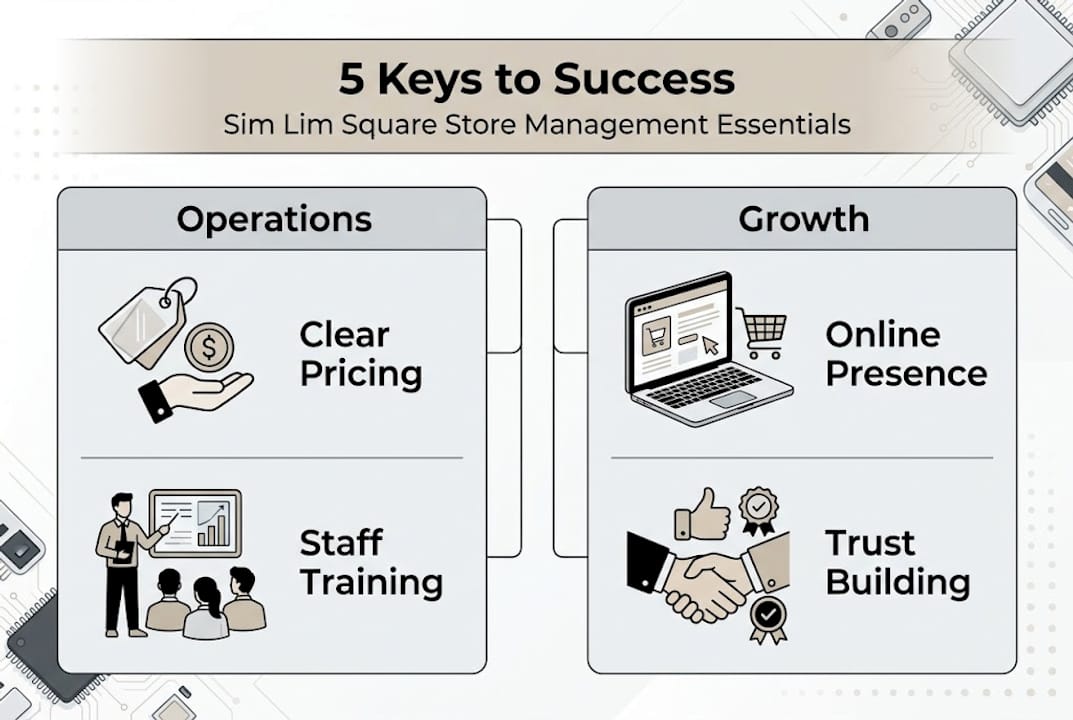
- Conduct marketplace research. Survey competitor prices weekly, both in-store and online. Know what the top-selling SKUs are moving for across the mall.
- Benchmark your prices. Set prices that are competitive but sustainable. Undercutting to win a single sale at zero margin is a losing strategy.
- Partner with reputable suppliers. Sourcing from verified distributors protects you from counterfeit stock and gives you warranty credibility with customers.
- Hire for attitude, train for skill. A staff member who is honest and patient with customers is worth more than one who can close a hard sell.
- Build an online presence. A Google Business profile, active social media, and listings on price comparison sites extend your reach beyond foot traffic.
| Approach | Walk-in only | Hybrid (physical + online) |
|---|---|---|
| Customer reach | Limited to mall visitors | Broader, includes online shoppers |
| Price transparency | Varies by negotiation | Publicly visible, builds trust |
| Resilience to foot traffic dips | Low | Higher |
| Reputation management | Reactive | Proactive |
For stores operating on upper floors, studying the stores at Level 4 directory can help you identify which product categories are already well-served and where gaps exist.
Pro Tip: When negotiating bundle deals with suppliers, ask for tiered pricing based on monthly volume targets rather than one-off order sizes. This gives you flexibility to offer genuine bundle discounts to customers without destroying your margin on individual units.
Display your prices clearly. A printed price tag is not a weakness. It signals confidence in your pricing and immediately separates you from stores that rely on ambiguity to overcharge.
Execution: In-store strategies for building trust and sales
Once your operations are properly set up, focus shifts to what happens in-store, where customer interaction makes or breaks your reputation. The gap between a mediocre store and a trusted one is almost always in the daily execution.
The bargaining dynamics at Sim Lim Square mean customers expect a conversation, not a transaction. Your staff needs to be trained to handle that conversation with honesty and product knowledge, not pressure.
Best practices for transparent, trust-building in-store operations:
- Post prices visibly. Customers who see a price tag feel safer. Those who have to ask are already slightly on guard.
- Confirm all terms in writing. For any sale involving a bundle, warranty, or accessory inclusion, document it on the receipt before payment.
- Handle bargaining with a floor. Train staff to negotiate within a defined range. Never let desperation for a sale push you below cost.
- Avoid pressure tactics entirely. High-pressure closes might win one sale and lose ten future ones through bad reviews.
- Use digital proof points. Display your Google review rating, show customer testimonials, and keep your social media updated with real product photos.
Bundle deals, done honestly, are one of the most effective sales tools in this market. Pair a laptop with a bag and a mouse at a combined price that feels like a deal. Customers love the convenience, and you move more units per transaction.
Staff training should cover three core areas: product knowledge, greeting and rapport-building, and complaint resolution. A staff member who can answer a technical question confidently closes more sales than one who has to check with a manager every time.

Because mall management has limited authority over strata-owned shops, your store’s behavior is entirely your own responsibility. There is no safety net. Stores that pivot to hybrid models and invest in online advertising consistently outperform those that rely solely on walk-in traffic, especially as e-commerce continues to grow.
Pro Tip: When a customer raises a complaint in-store, resolve it immediately and visibly. Other customers watching how you handle a problem are more likely to trust you than if no issue had come up at all.
For a closer look at how high-traffic floor layouts affect customer flow, both the stores at Level 1 directory and the Sim Lim Square tech video tour offer practical visual context.
Verification and continuous improvement: Monitoring, reviews, and crisis handling
The long-term success of your Sim Lim Square store depends on your ability to measure, adapt, and bounce back from any crisis. Execution without measurement is guesswork.
Track these KPIs on a daily and weekly basis:
| KPI | Frequency | Target |
|---|---|---|
| Customer complaints received | Daily | Zero unresolved |
| New Google reviews posted | Weekly | Respond within 48 hours |
| Bundle deals closed | Daily | Track conversion rate |
| Positive online mentions | Weekly | Increase month on month |
| Staff training sessions completed | Monthly | At least one per month |
When a complaint does come in, how you handle it matters more than the complaint itself. Follow these steps:
- Listen without interrupting. Let the customer state the full issue before responding.
- Correct the problem immediately. Offer a refund, replacement, or resolution on the spot where possible.
- Follow up in writing. Send a message or receipt note confirming what was resolved.
- Publicly acknowledge improvement. If a complaint leads to a policy change, say so. Post it on your Google profile or social media.
“Even a few errant retailers taint the reputation of hundreds. Your customer sees you first, not the mall’s management policy.”
With over 500 shops competing for attention, your online reputation is a genuine differentiator. Monitor Google Reviews weekly. Set up alerts for your store name on social media. Check forums like HardwareZone for mentions.
For crisis recovery, the playbook is straightforward: issue a clear public apology if warranted, update your internal policies, retrain affected staff, and document the changes. Stores that handle crises transparently often recover faster than those that go quiet. The Sim Lim Square case studies on Wikipedia show how public incidents have shaped the mall’s reputation over time, and what distinguishes stores that survived from those that did not.
For stores on the upper floors, the stores at Level 6 directory shows how specialty retailers have carved out loyal niches by focusing on service quality over volume.
Why Sim Lim Square’s reputation is everyone’s problem (and hidden opportunity)
It is easy to blame the handful of bad actors or point to management’s limited authority over strata-owned units. But that framing misses the real opportunity sitting right in front of every honest retailer.
Skeptical customers are actually your best potential advocates. A shopper who walks into Sim Lim Square expecting the worst and leaves your store genuinely impressed does not just come back. They tell people. They post reviews. They become the word-of-mouth engine that no advertising budget can replicate.
Stores that treat the mall’s reputation problem as a marketing problem consistently outperform their peers. When you display prices clearly, confirm terms in writing, and resolve issues without drama, you are not just being ethical. You are differentiating yourself in a market where trust is genuinely scarce.
The stores that have weathered the mall’s most difficult reputation cycles are almost always the ones that went digital early, built a presence beyond foot traffic, and treated every customer interaction as a long-term investment. For a broader view of how Sim Lim Square compares to other retail destinations and what that means for positioning your store, the Sim Lim Square vs Funan Mall comparison is worth exploring. The opportunity is real. The skepticism in the market is your competitive moat, if you are willing to clear it.
Take your Sim Lim Square store to the next level
The strategies in this guide only work when you apply them with the specific context of your floor, your product category, and your customer base in mind. Sim Lim Square Insider is built to give you exactly that level of detail.
Start by exploring the explore Basement 1 stores directory to understand what your competition looks like at ground level. Then check the stores at Level 3 guide to see how mid-floor retailers are positioning themselves. For ongoing tips, market insights, and community resources tailored to Sim Lim Square retailers, get more Sim Lim Square tips and stay ahead of the curve with content built specifically for store owners like you.
Frequently asked questions
How can I avoid reputation risks when managing a store at Sim Lim Square?
Always use transparent pricing, confirm all sales in writing, and stay updated on reputational alerts or advisories for the mall. A history of scams and CASE advisories shows how quickly trust erodes when basic ethical standards slip.
What are the best ways to research market prices in Sim Lim Square?
Check online forums, compare listings from reputable shops, and consult recent price guides before setting your prices. HardwareZone price research is one of the most reliable starting points for understanding real market rates.
Which floors in Sim Lim Square are safest for avoiding scams?
Most patrons recommend starting from the third floor and above, and choosing established, reputable shops. Avoid first two floors if you are unfamiliar with which stores have a solid track record.
How should I handle customer complaints effectively?
Respond promptly, address issues openly, follow up with corrective action, and thank the customer for feedback. Transparent complaint resolution steps turn unhappy customers into proof that your store takes accountability seriously.