

Why compare tech retailers in Singapore for smart shopping
TL;DR:
- Price is only one factor; consider warranty, after-sales support, and total cost of ownership.
- Buying from authorized retailers ensures product authenticity, local warranty, and reliable support.
- Use online tools, store visits, and timing strategies to compare deals and shop smart in Singapore.
You’re standing in a store, eyeing a laptop that’s $80 cheaper than everywhere else you’ve checked. Sounds like a win. But what if that price gap comes with a grey market warranty, no local after-sales support, and a return policy that’s basically nonexistent? Singapore’s electronics retail scene is one of the most competitive in Asia, with retailers like Challenger, Courts, Harvey Norman, Best Denki, Lazada, and Shopee all fighting for your dollar. Knowing how to compare them properly, beyond just sticker price, can save you from costly mistakes and help you walk away with the best possible deal every single time.
Table of Contents
- Why price isn’t everything: The value of smart comparisons
- Comparing key factors: Warranty, authenticity, and after-sales support
- How Singaporeans compare: Practical strategies and tools
- Navigating tricky situations: Grey market, negotiation, and high-end tech
- The hidden equation: What most shoppers still overlook
- Shop smart with insider tips on Singapore tech deals
- Frequently asked questions
Key Takeaways
| Point | Details |
|---|---|
| Compare beyond price | Checking warranty, service, and authenticity ensures lasting value, not just a cheap deal. |
| Use the right tools | Online platforms, price matching, and sale timing can save you hundreds on electronics. |
| Avoid risky sellers | Grey market and third-party sellers can cost you more in the long run with fakes or no support. |
| Strategize your shopping | Blend online research with in-store visits and negotiate where possible for the best outcome. |
Why price isn’t everything: The value of smart comparisons
Price is the first thing most people check. That’s completely natural. Singapore’s tech retail market is intensely competitive, and retailers constantly compete through promotions and flash discounts to win customers. Challenger runs member sales, Courts offers installment deals, and online platforms like Lazada and Shopee push aggressive 11.11 or 12.12 discounts. On the surface, this looks like a shopper’s paradise.
But chasing the lowest number without thinking about what comes with it is where many buyers go wrong. A product listed at $50 less than the market average might come with a regional warranty that’s not honored locally, or a return window so short it’s practically useless. Some sellers on online marketplaces bundle in accessories you don’t need to inflate perceived value, while quietly excluding the local warranty that protects you for the next two years.
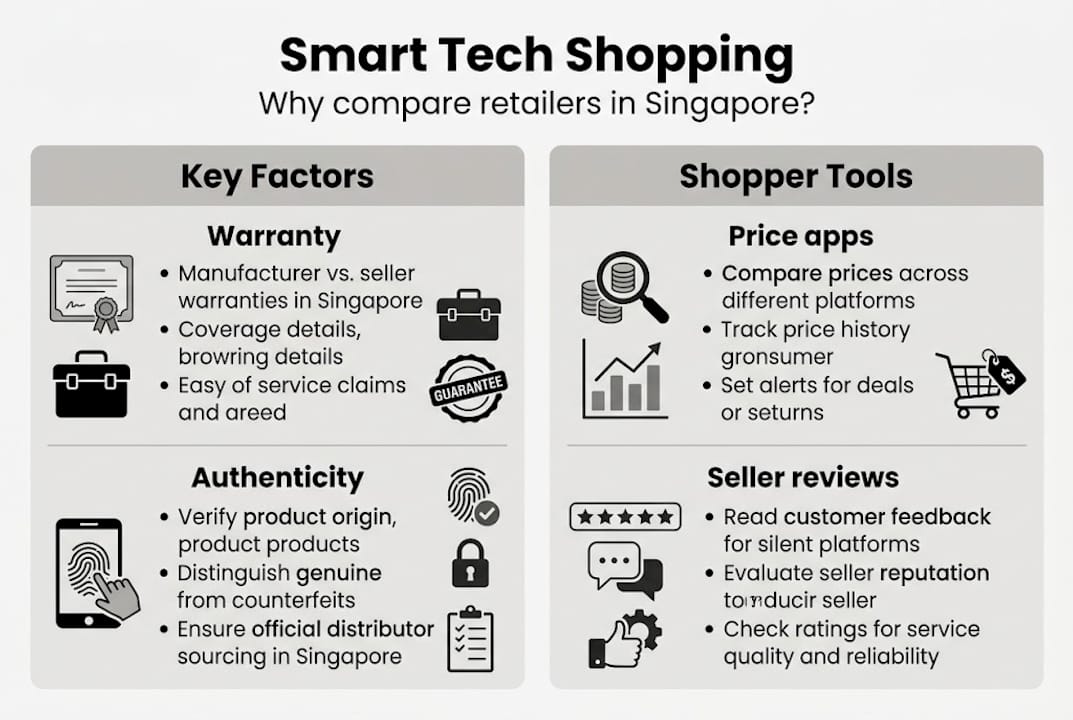
The smarter framework is total cost of ownership (TCO), which means calculating the real cost of a purchase over its useful life. TCO includes the purchase price, warranty costs, repair expenses, delivery fees, and even the time you’d spend dealing with a bad return experience. When you compare prices diligently across multiple channels, you start to see that the cheapest upfront option is rarely the cheapest in the long run.
Here’s what savvy Singapore shoppers factor into every tech purchase:
- Local warranty coverage (is it one year or two? Is it handled locally or overseas?)
- Return and exchange policy (how many days? What condition must the item be in?)
- Delivery fees (free delivery thresholds vary widely between retailers)
- Bundled accessories (are they genuine or third-party substitutes?)
- After-sales service centers (how close is the nearest authorized repair center?)
- Retailer reputation (check Google reviews, HardwareZone forums, and Reddit Singapore)
Pro Tip: Before finalizing any tech purchase, add up the full TCO including warranty extensions and delivery. A product that costs $30 more upfront but includes a two-year local warranty often works out cheaper than the “deal” with no local support.
Visiting Sim Lim Square tech deals is a great starting point for understanding how competitive pricing actually works in Singapore’s most iconic tech hub, where dozens of stores compete side by side on the same floor.
Comparing key factors: Warranty, authenticity, and after-sales support
While price often grabs attention, it’s just one piece. Equally crucial are what happens after you buy, authenticity, and the safety net retailers provide.
Buying from an authorized retailer means the brand officially recognizes that store as a legitimate seller. Authorized dealers offer better protection than grey market or third-party sellers, including valid local warranties, access to official repair services, and genuine products. Grey market goods, on the other hand, are products imported outside the brand’s official distribution channels. They might look identical, but the warranty is often tied to the country of origin, not Singapore.
Here’s a structured comparison to help you understand the difference:
| Factor | Authorized retailer | Grey market / unofficial seller |
|---|---|---|
| Product authenticity | Guaranteed | Not guaranteed |
| Local warranty | Yes, typically 1 to 2 years | Often none or overseas only |
| After-sales support | Official service centers | Third-party or none |
| Return policy | Clear and enforceable | Vague or absent |
| Price | Market rate | Often lower |
| Risk level | Low | Medium to high |
The risk of counterfeits is real, especially for high-demand items like earbuds, smartwatches, and phone accessories. A counterfeit AirPods listing on an online marketplace might look convincing in photos, but the audio quality, battery life, and safety standards are nowhere near the genuine product.
How do you check if a retailer is authorized? Follow these steps:
- Visit the brand’s official Singapore website and look for an “authorized retailers” or “where to buy” page.
- Call or email the brand directly to confirm if a specific store is on their list.
- Ask the seller for proof of authorized status, such as a dealer certificate or official invoice.
- Check community forums like HardwareZone or Reddit Singapore for user experiences with that specific store.
- Look for official brand signage or certification displayed in the store itself.
“The warranty is the product’s insurance policy. A device without local warranty coverage isn’t just a risk, it’s a liability you’re choosing to carry yourself.”
Understanding how Sim Lim Square fits into this picture is important. The mall hosts both authorized dealers and independent resellers. Knowing how to navigate its multiple levels helps you identify which stores carry official stock versus grey market imports.
How Singaporeans compare: Practical strategies and tools
Knowing what to compare is powerful. Here are the best ways savvy shoppers in Singapore actually do these comparisons step by step.
Singapore shoppers are among the most price-conscious in Southeast Asia, and they’ve developed a sharp set of tools and habits to make sure they never overpay. The most effective strategy combines online research with in-person visits, using each channel for what it does best.
Price comparison tools like iPrice, combined with checking multiple platforms both online and offline, price matching at stores like Courts and Challenger, and timing purchases around events like the Great Singapore Sale or IT Show, are the core mechanics of smart tech shopping in Singapore. These aren’t just tips, they’re habits that experienced buyers use on every single purchase.
Here’s a practical comparison of the most popular research methods:
| Method | Best for | Time required | Reliability |
|---|---|---|---|
| iPrice or PriceSpy | Cross-platform price tracking | 5 to 10 minutes | High |
| HardwareZone forums | User reviews and seller reputation | 15 to 30 minutes | Very high |
| In-store visits | Testing products physically | 1 to 2 hours | Excellent |
| Retailer apps (Challenger, Courts) | Flash deals and member prices | 5 minutes | High |
| Shopee / Lazada search | Widest price range | 10 to 20 minutes | Medium |
Key habits to build into your shopping routine:
- Use iPrice or PriceSpy to track price history and spot genuine discounts versus inflated “original” prices.
- Check seller ratings carefully on Shopee and Lazada. Look for sellers with at least 4.8 stars and hundreds of reviews, not just a handful.
- Visit stores physically before buying online. Testing a keyboard, feeling a laptop’s build quality, or hearing headphones in person gives you information no product listing can.
- Ask for price matching at Courts or Challenger. Both retailers have price match policies, and a quick screenshot of a competitor’s price can save you real money on the spot.
- Time your purchases around the IT Show (usually held in March), the Great Singapore Sale (June to July), and year-end sales in November and December.
Pro Tip: Cross-reference seller ratings across multiple platforms. A seller with 4.9 stars on Shopee but no presence on HardwareZone forums is worth researching further before committing to a high-value purchase.
For the best combination of deals and in-person testing, exploring best Sim Lim Square deals alongside other deal platforms gives you a well-rounded picture of what’s available across Singapore’s tech retail landscape.
Navigating tricky situations: Grey market, negotiation, and high-end tech
But what about those tricky situations that can trip up even the smart shopper? Let’s explore a few, so you’re never caught off guard.
Sim Lim Square is famous for its competitive prices, but it’s also known for situations where uninformed shoppers have been pressured into buying overpriced accessories or signing up for unnecessary service packages. The good news is that these situations are avoidable with the right preparation.
Negotiation is possible at Sim Lim Square, but it comes with the need to be alert to counterfeits and high-pressure tactics. Here’s how to negotiate smartly and safely:
- Research your target price before you walk in. Know the market rate from at least three sources before entering any store.
- Ask for the final price upfront. Say clearly: “What’s your best price, all in, including warranty?” This prevents add-ons from appearing after you’ve agreed on a number.
- Walk away if pressured. Legitimate sellers don’t pressure you. If a salesperson becomes aggressive or insists you must decide immediately, leave.
- Inspect the box and seal. Genuine products come in factory-sealed packaging. Ask to inspect the box before paying.
- Pay by card when possible. Card payments offer some chargeback protection if something goes wrong after the sale.
“A deal that requires pressure to close is not a deal. It’s a trap with a discount sticker on it.”
When it comes to online shopping, red flags include listings with no seller reviews, prices that are 30% or more below market rate, and sellers who insist on payment outside the platform’s secure checkout. Online marketplaces require checking seller ratings carefully, and for high-value items, sticking to established retailers with official storefronts on Shopee or Lazada is the safer move.
For premium products like Apple devices, the price premium is real. Apple products in Singapore often cost more due to import costs and official distribution markups. Alternatives like authorized resellers or certified refurbished units from Apple’s own website can offer genuine savings without sacrificing warranty protection. Knowing which Sim Lim Square stores carry authorized Apple products versus grey market stock is a key advantage for any Apple shopper.
The hidden equation: What most shoppers still overlook
Here’s the frank truth that most shopping guides won’t tell you: the single biggest mistake Singapore tech buyers make isn’t paying too much. It’s optimizing for the wrong variable entirely.
Most people walk into a purchase thinking about price. Experienced buyers think about outcomes. What happens if this device fails in six months? Who do I call? How long will the repair take? Will I need to ship it overseas? These questions matter far more than saving $40 upfront.
The smartest buyers in Singapore use a hybrid strategy. They test products physically in stores like Sim Lim Square or Challenger, where they can feel build quality, test keyboards, and compare screen brightness side by side. Then they buy from whichever channel offers the best combination of price, warranty, and support. Sometimes that’s the physical store. Sometimes it’s the retailer’s official online shop. The key is never letting price alone make the decision.
Always factor in TCO including warranties and returns, use physical stores for testing products, and rely on online channels for price transparency. Cross-border shopping from Malaysia or overseas platforms can tempt with savings of 10 to 20%, but customs duties, the absence of local warranty, and the hassle of overseas returns can wipe out those savings entirely.
The Sim Lim Square guide is one of the best resources for understanding how to combine in-person and online strategies effectively, because the mall itself represents the full spectrum of Singapore’s tech retail options in one building.
Shop smart with insider tips on Singapore tech deals
Ready to put your comparison skills to the test and save more when shopping for tech in Singapore?
Sim Lim Square Insider gives you the tools to go beyond generic advice and make genuinely informed decisions. From detailed store directories to video walkthroughs of every floor, the platform is built specifically for Singapore tech shoppers who want more than a price list.
Whether you want to explore Sim Lim Square and Funan Mall comparisons, browse the complete Basement 1 store list before your next visit, or watch tech tour videos to plan your route through the mall, Sim Lim Square Insider has you covered. Stop guessing and start shopping with confidence.
Frequently asked questions
What is the biggest risk when buying electronics from unauthorized sellers in Singapore?
You risk receiving fake products, voided warranties, and zero after-sales support, since authorized dealers offer better protection than grey market or third-party sellers in every measurable way.
How do I check if a tech retailer is authorized in Singapore?
Visit the brand’s official Singapore website for an authorized retailer list, or contact the brand directly and ask for written confirmation of the store’s authorized status.
When is the best time to buy electronics in Singapore for deals?
Sales like the Great Singapore Sale and the IT Show consistently deliver the best tech discounts, with year-end sales in November and December also offering strong deals across most categories.
Can you negotiate prices in Singapore tech markets?
Yes, negotiation is possible at Sim Lim Square, particularly for accessories, bundles, or when buying multiple items, but always confirm the final all-in price before agreeing to anything.
Is buying from online marketplaces in Singapore safe?
It’s generally safe when you stick to sellers with strong ratings and verified reviews, but checking seller ratings carefully is essential, especially for high-value items where counterfeits are more common.