

Sim Lim Square Commercial Trends 2026: Key Insights
TL;DR:
- Most investors mistake Singapore’s retail trends for Sim Lim Square’s unique tech-focused dynamics in 2026. Floor position and local repeat customers are critical for tenant success, unlike general retail patterns. The mall’s specialty nature makes strategic tenant pairing and floor selection vital for sustainable investment returns.
Most investors analyzing Singapore’s retail market in 2026 make one costly mistake. They assume that whatever is happening to Orchard Road rents or suburban mall vacancies tells them something useful about Sim Lim Square commercial trends 2026. It does not. Sim Lim Square operates under its own commercial logic, shaped by tech-specific consumer behavior, floor-by-floor traffic dynamics, and a buyer base that splits sharply between price-hunting locals and visiting tourists. This guide breaks down what is actually happening at Sim Lim Square in 2026 and what it means for investors, retailers, and business owners making real decisions.
Table of Contents
- Key Takeaways
- Singapore’s retail market backdrop in 2026
- Sim Lim Square commercial trends 2026 in depth
- How Sim Lim Square compares to nearby tech hubs
- The 2026 market outlook and what it means for investors
- My honest take on investing in Sim Lim Square
- Explore Sim Lim Square with expert guidance
- FAQ
Key Takeaways
| Point | Details |
|---|---|
| Macro trends mislead investors | Singapore’s retail vacancy and rent data does not reflect Sim Lim Square’s tech hub dynamics accurately. |
| Floor position matters enormously | Upper-floor units face structurally lower footfall, making level selection the single biggest risk factor for tenants. |
| Muted supply supports rents | Limited new retail completions in 2026 create favorable conditions for stable occupancy at well-positioned units. |
| Repeat locals drive sustainability | Long-term retail success at Sim Lim Square depends more on local tech enthusiasts than on tourist foot traffic. |
| Experiential retail is rising | Tenants offering hands-on product testing and specialist advice are gaining competitive ground over pure price-based sellers. |
Singapore’s retail market backdrop in 2026
Before you can understand what makes Sim Lim Square different, you need a clear picture of the wider market it sits inside. Singapore’s overall retail conditions in 2026 are mixed but generally stable, and that backdrop matters for context even if Sim Lim Square does not track it precisely.
Retail rents in Singapore’s central region dipped 0.6% in Q1 2026. That sounds alarming, but the full story is more nuanced. Prime retail rents are forecast to rise between 1% and 4% over the full year, which tells you that the softening is concentrated in secondary and fringe locations, not in well-positioned, high-demand assets. Sim Lim Square, with its prominent spot near Bugis MRT and its concentrated tech retail identity, sits closer to the resilient end of that spectrum.
The broader vacancy picture reinforces this. Singapore’s retail vacancy rate held at 6.3% in Q1 2026, with a notable split between strong performers and weaker secondary locations. The Orchard corridor actually saw vacancy edge up to 7.1%, while suburban OCR locations tightened to 4.1%. This bifurcation is the most important structural theme in Singapore’s commercial property market right now.
Here is what that data actually signals for investors:
- Tight supply at the national level is doing a lot of the work in keeping occupancy stable.
- New retail space completions are expected to run slightly below the five-year average in 2026, with further tapering into 2027 before any major redevelopment pipeline arrives.
- Well-located, category-specific retail, including specialist tech hubs, is outperforming generalist formats.
Critically, none of these headline figures capture the floor-level economics and tech-specific consumer dynamics that actually drive performance inside Sim Lim Square. That requires a separate analysis entirely.
Sim Lim Square commercial trends 2026 in depth
Sim Lim Square is not a conventional shopping mall, and treating its commercial trends like one is where most investors go wrong. It is Singapore’s flagship destination for electronics including gaming gear, PC components, cameras, and audio equipment. That specialization creates a completely different set of commercial dynamics.
Floor-specific traffic risk
The single most consequential factor in any Sim Lim Square tenancy is floor position. Lower floors attract the majority of footfall, particularly casual shoppers, tourists, and first-time visitors. Upper floors skew toward specialist buyers who already know exactly what they want and who they want to buy it from. Understanding Sim Lim Square’s floor dynamics is non-negotiable before committing to any unit.
The bifurcation between well-positioned tech retail spaces and weaker secondary floors creates genuine risk AND genuine opportunity. A ground-floor unit with strong passing trade and a well-merchandised window commands a rental premium that is more than justified. An upper-floor unit with the right specialist tenant, think a niche PC builder or professional camera repair service, can still perform if that tenant has an established local following.
Price comparison behavior and tenant sustainability
Pricing strategy and consumer purchase power at Sim Lim Square are shaped by buyers who arrive having already researched online prices. This is a double-edged reality. On one hand, it keeps margins tight for tenants competing purely on price. On the other hand, tenants who combine competitive pricing with genuine expertise, hands-on demos, and trustworthy advice convert browsers into loyal repeat customers at higher rates than pure-price sellers.
Local repeat customers versus tourist footfall
Tourist-driven footfall creates transaction volume but not loyalty. Local tech enthusiasts and hobbyists who return for accessories, upgrades, and specialist repairs are the spine of sustainable revenue for most Sim Lim Square retailers.
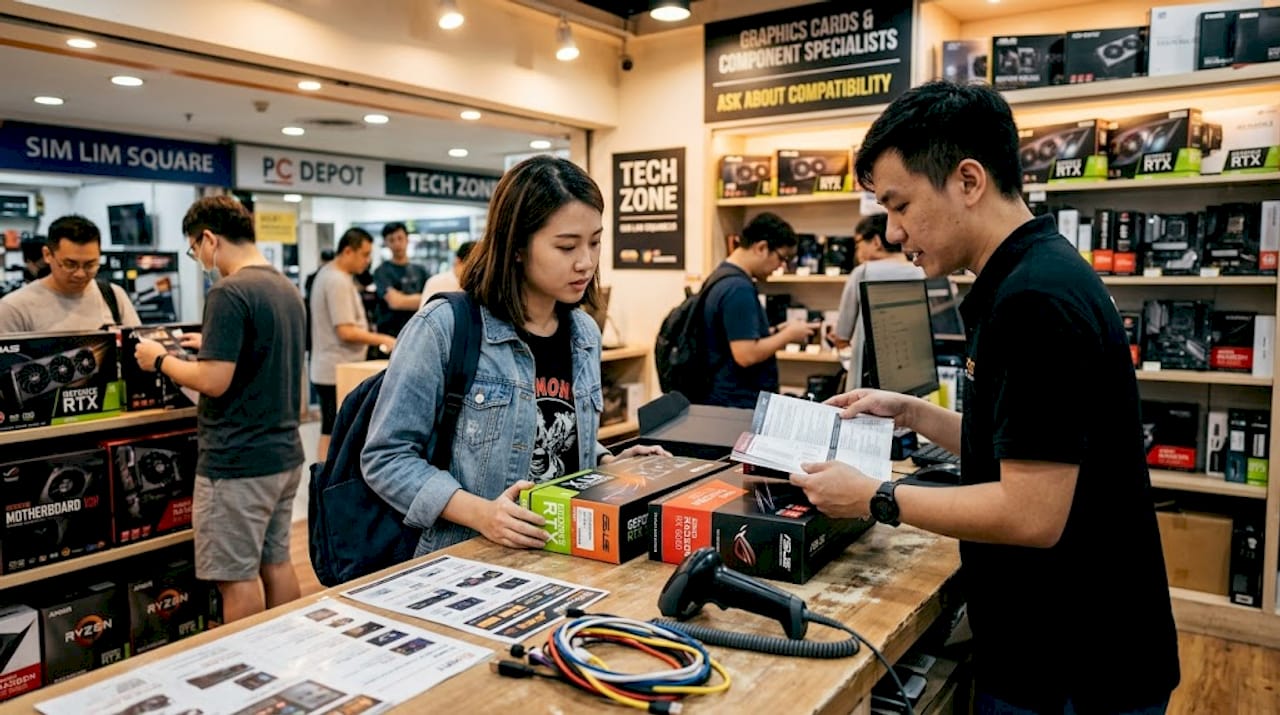
Pro Tip: If you are evaluating a unit for investment or tenancy, ask current occupants what percentage of their sales come from returning local customers. That figure is a more reliable indicator of commercial health than raw foot traffic counts.
How Sim Lim Square compares to nearby tech hubs
Investors evaluating Sim Lim Square as a commercial opportunity benefit from a direct comparison with competing destinations, particularly Funan Mall and the broader Bugis retail cluster. Each has a distinct positioning that affects tenant mix, rental levels, and the type of visitor they attract.
Sim Lim Square’s location near Bugis MRT places it within a high-traffic retail corridor, but its identity as a specialist electronics mall means it draws a fundamentally different buyer than lifestyle-oriented malls nearby.
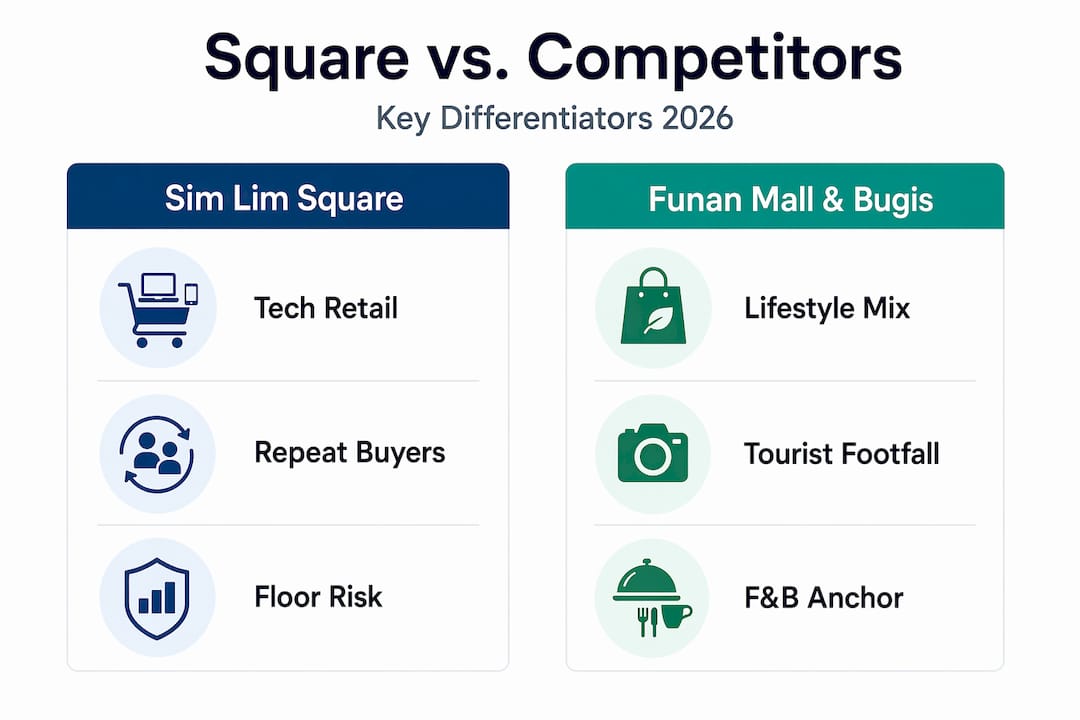
| Factor | Sim Lim Square | Funan Mall | Bugis Junction |
|---|---|---|---|
| Primary tenant focus | Tech, electronics, components | Tech, lifestyle, F&B | Fashion, F&B, lifestyle |
| Shopper profile | Tech enthusiasts, bargain hunters | Mixed lifestyle and tech | General retail consumers |
| Experiential offerings | Product testing, repair services | Co-working, sports, F&B | Dining, entertainment |
| Rental price point | Mid-range to value | Premium | Premium |
| Investor appeal | Specialist category depth | Lifestyle diversification | Broad consumer traffic |
The comparison reveals a clear truth. Funan Mall competes in the same tech retail space but layers in lifestyle and F&B to broaden its appeal and justify higher rents. Retailers increasingly prioritize locations with curated tenant mixes and dwell-time enhancing concepts. Sim Lim Square’s strength is its concentration and depth of tech specialists, which no lifestyle mall can replicate for a serious buyer who wants to compare five brands of mirrorless cameras side by side on the same floor.
The opportunity for investors is clear: a well-positioned Sim Lim Square unit with a specialist tech tenant offers category-level depth that broader malls cannot match. The challenge is that this same specialization narrows the tenant pool and requires careful selection to sustain occupancy.
The 2026 market outlook and what it means for investors
Putting all the data together, the 2026 outlook for Sim Lim Square commercial real estate is cautiously positive, with specific conditions that separate winning positions from weaker ones.
Here is what the forward-looking picture actually suggests:
- Limited supply creates a floor on rents. With new retail completions below five-year averages in 2026 and tapering further into 2027, vacancy pressure should remain manageable. For existing Sim Lim Square unit holders, that is a structural tailwind.
- Prime rents have upside. Prime retail baskets rose 3% year-on-year, and well-located ground and second-floor units at Sim Lim Square share some of that prime-location logic even within a specialist mall context.
- Experiential retail is shaping tenant demand. Tech retailers who offer test-before-you-buy setups, specialist repair bays, and in-store consultation are pulling ahead of pure box-shifters. Investors should weight this when evaluating prospective tenants, not just their current revenue figures.
- Tenant curation is becoming a competitive lever. Landlords and unit owners who actively shape their tenant mix, pairing complementary specialists rather than accepting any occupant, are seeing stronger lease renewal rates.
Pro Tip: When reviewing 2026 market predictions for tech retail investment, separate footfall data by source. Tourist traffic shows up in the counts but converts at lower value per visit. A unit with 60% returning local customers and modest absolute traffic often outperforms a unit with high tourist volume on pure revenue terms.
The adaptability theme is the one that will define the next three to five years at Sim Lim Square. Retailers who treat the mall as a static price-comparison venue will face pressure. Retailers who build genuine knowledge-based differentiation will find it a very defensible commercial position.
My honest take on investing in Sim Lim Square
I have watched investors come into Sim Lim Square applying the same criteria they would use for a suburban strip mall or an Orchard Road asset. Almost all of them have to recalibrate quickly, and some learn that lesson expensively.
The thing I find most consistently misunderstood is floor risk. People look at the building as a single investment and average out the performance. In practice, the difference between a ground-floor unit with a well-established PC retailer and an upper-floor unit with a weak tenant is not 10% or 15% in returns. It can be the difference between a fully functioning investment and a persistent vacancy problem.
What I have also seen is that the best tenants at Sim Lim Square are not the ones who win on price. They win because they have deep product knowledge and they have trained their customers to trust them for the next upgrade cycle. That relationship is a commercial asset that belongs partly to the tenant and partly to the location. When you find a tenancy like that, you protect it.
My practical advice for 2026: do not buy the building, buy the position. Understand which floors and which unit positions generate durable, repeat-customer-driven foot traffic. Use store management strategies as your benchmark for evaluating prospective tenants, not just their current lease terms. And always separate the macro Singapore retail data from what is actually happening inside the mall. They tell different stories.
— Aloysius
Explore Sim Lim Square with expert guidance
Making confident commercial decisions at Sim Lim Square starts with having the right resources at hand. Simlimsquareinsider is built specifically for investors, business owners, and retailers who need more than generic market commentary.
Whether you are analyzing unit positions for acquisition, evaluating tenant viability, or scoping out how Sim Lim Square competes with other tech hubs, Simlimsquareinsider has the tools to back your research. Connect with professional agent services for hands-on support with commercial property transactions, or get an immersive overview through the Sim Lim Square tech video tours to understand the mall’s layout, tenant concentration, and floor dynamics before committing to any decision. The site also offers detailed tech deal guides that reflect real buyer behavior, giving you ground-level insight into the consumer patterns that drive commercial performance.
FAQ
What are the main commercial trends at Sim Lim Square in 2026?
The most significant trends are rising demand for experiential retail concepts, floor-specific performance divergence, and strong occupancy supported by a limited new supply pipeline across Singapore’s retail sector.
How does Sim Lim Square differ from broader Singapore retail trends?
Sim Lim Square’s performance is driven by tech-specific consumer behavior including repeat local buyers and specialist product demand, factors that do not track closely with Singapore-wide retail vacancy or rental data.
Is Sim Lim Square a good investment opportunity in 2026?
Well-positioned lower-floor units with established specialist tenants represent a solid investment case in 2026, particularly given muted new supply and stable overall vacancy rates in Singapore.
How does floor position affect commercial returns at Sim Lim Square?
Lower floors generate significantly higher natural footfall than upper floors, which means floor selection is the primary risk variable investors must evaluate before acquiring any unit in the building.
How is Sim Lim Square evolving compared to competitors like Funan Mall?
Sim Lim Square is deepening its position as a specialist tech destination focused on depth and expertise, while Funan Mall targets a broader lifestyle audience. Both serve distinct buyer profiles and are not directly interchangeable for serious tech consumers.
Recommended
- Sim Lim Square store management: 5 strategies for success – Sim Lim Square Insider
- Sim Lim Square levels explained: navigate Singapore’s tech hub – Sim Lim Square Insider
- Sim Lim Square buying guide for savvy shoppers – Sim Lim Square Insider
- Top 3 citicommercial.com.sg Alternatives 2026 – Sim Lim Square Insider