

Best Thermal Sensor Singapore: Top Suppliers Compared
For industrial and commercial buyers, the four suppliers that consistently deliver in Singapore are Meridian Innovation, Keyence, Thermotron-CE, and Acez Sensing. Each covers a distinct slice of the market, from CMOS thermal imaging to explosion-proof thermocouples with SAC-SINGLAS accredited calibration. The comparison below cuts straight to what separates them.
| Supplier | Product Type | Temperature Range | Certifications | Application Fit | Calibration Available |
|---|---|---|---|---|---|
| Meridian Innovation | CMOS thermal imaging sensors | Not publicly listed | — | High-end industrial imaging, safety monitoring | — |
| Keyence | Digital infrared temperature sensors | Up to 1350°C | — | Non-contact measurement, diverse industrial settings | — |
| Thermotron-CE | Thermocouples, RTDs, Ex-proof sensors | Custom fabrication | ATEX/IECEx, CE | Hazardous zones, Green Mark buildings | SAC-SINGLAS ISO 17025 |
| Acez Sensing | RTDs, thermocouples, Ex-proof sensors | Up to 2000°C (3632°F) | ATEX/IECEx | Oil and gas, aerospace, semiconductor | SAC-SINGLAS (via Isolab) |
What sets each thermal sensor supplier apart?
Thermotron-CE has operated since 1991 and built its reputation on custom fabrication rather than off-the-shelf parts. Its in-house calibration lab at the Bukit Batok facility carries SAC-SINGLAS ISO 17025 accreditation and offers both metrology and mapping calibration, on-site or in-house. For Green Mark compliance, Thermotron-CE manufactures high-accuracy thermistors rated at ±0.05°C for chilled water inlet and outlet measurements, fully aligned with SS 591.
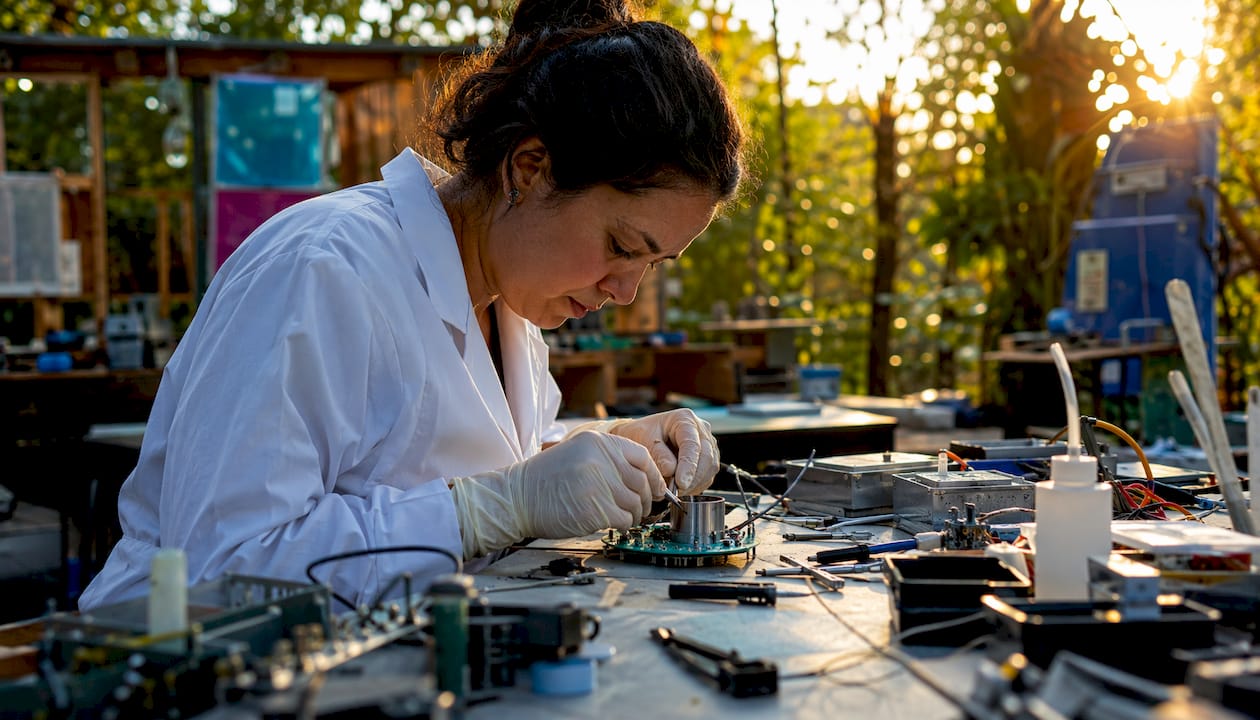
Acez Sensing targets the most demanding environments. Its Ex-proof sensors operate in Zone 1 and Zone 2 hazardous areas, meet ATEX and IECEx standards, and handle temperatures up to 2000°C. Calibration runs through Isolab Singapore, a SAC-SINGLAS accredited sister company with over a decade of temperature, humidity, and pressure calibration experience.
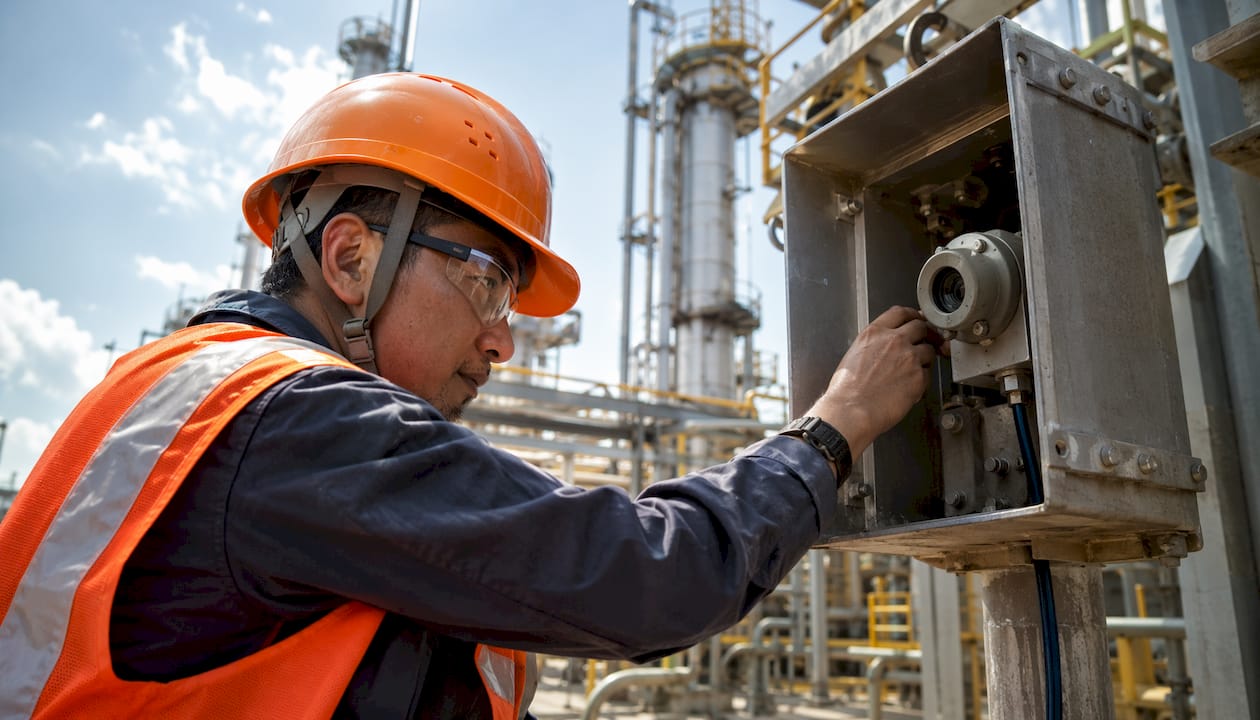
Keyence’s FT Series digital infrared sensors cover up to 1350°C with fast response and high repeatability. No emissivity setting is required, and the detecting distance is unlimited, which makes them practical for production lines where contact measurement is not feasible.
Meridian Innovation focuses on CMOS-based thermal imaging, a technology that delivers higher resolution and lower power consumption than traditional microbolometer designs. Their sensors serve industrial safety and monitoring applications across Singapore and international markets.
Key features by supplier:
- Thermotron-CE: Custom thermocouple wires, extension cables, thermowells, hydrostatic and ultrasonic testing, PMI verification, NIST-traceable wire supply via TE Wire & Cable (USA)
- Acez Sensing: RTD and thermocouple Ex-proof configurations, corrosion-resistant housings, ambient range of -30°C to +85°C, integration into larger control systems
- Keyence: Compact sensor head, high-speed response, long-range non-contact detection, broad lineup including ultra-long-range models
- Meridian Innovation: CMOS sensor architecture, thermal imaging for safety and condition monitoring
How do you choose the right thermal sensor?
The operating environment narrows your options faster than any spec sheet. If your site falls under Zone 1 or Zone 2 hazardous area classification, ATEX or IECEx certification is not optional. Both Thermotron-CE and Acez Sensing manufacture sensors that meet those standards with local fabrication, which means shorter lead times and easier compliance documentation.
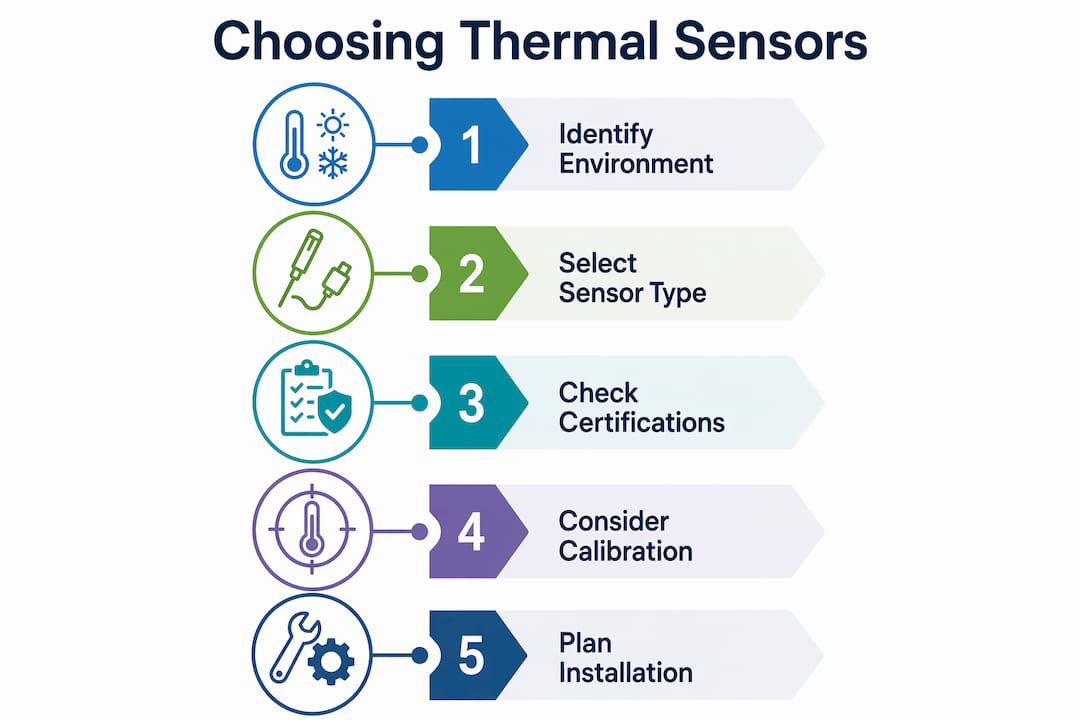
For Green Mark buildings, calibration uncertainty below 0.01°C is the threshold BCA audits require. General-purpose sensors rarely hit that mark without local recalibration.
Selection checklist:
- Temperature range required (process minimum and maximum)
- Hazardous area classification (Zone 0, 1, or 2)
- Accuracy and calibration traceability requirements
- Integration with existing BMS or SCADA systems
- Warranty coverage and local after-sales support
Pro Tip: Always request the calibration certificate with the sensor. A SAC-SINGLAS accredited certificate provides documented traceability, which speeds up BCA audits and insurance reviews.
Where are thermal sensors used in Singapore and the US?
Predictive maintenance is the fastest-growing application. Wireless IoT thermal sensors now allow continuous monitoring of electrical panels without opening them, cutting personnel risk and eliminating scheduled manual inspections. Singapore’s power sector has adopted this approach to protect high-value equipment and maintain uptime.
Other common deployments include:
- Chilled water systems in commercial buildings (Green Mark compliance)
- Electrical panel hotspot detection in data centers and factories
- Oil and gas process temperature control
- Pharmaceutical and semiconductor manufacturing
- Marine engineering and aerospace component testing
Singapore’s calibration and custom manufacturing capabilities
Singapore’s SAC-SINGLAS ISO 17025 accredited labs are among the few in the region capable of achieving measurement uncertainty below 0.01°C for RTDs and thermistors. That level of precision directly supports BCA Green Mark certification for chilled water systems.
- Local calibration labs: SAC-SINGLAS accredited, covering temperature, humidity, and pressure
- Custom fabrication: thermowells, explosion-proof housings, specialized thermocouple wire
- Testing services: hydrostatic, ultrasonic, dye penetration, wake frequency, and PMI
- Green Mark sensors: manufactured to SS 591, calibrated for measurement uncertainty below 0.01°C for chilled water monitoring
How much do thermal sensors cost in Singapore?
Pricing varies widely by sensor type and specification. Entry-level non-contact infrared sensors for maintenance use start at a few hundred Singapore dollars. Custom-engineered Ex-proof thermocouples with SAC-SINGLAS calibration certificates carry significantly higher costs, reflecting material selection, fabrication complexity, and accredited testing. Keyence’s FT Series sits in the mid-to-upper range for digital infrared sensors. Thermotron-CE and Acez Sensing price custom orders based on specification, quantity, and calibration scope. Request a formal quotation directly from each supplier for accurate project budgeting.
Installation and integration considerations
Most industrial sensors from Thermotron-CE and Acez Sensing are designed for integration with standard BMS and SCADA platforms. Thermotron-CE sensors are compatible with all major BMS and data acquisition systems, and built-in test ports on Green Mark models speed up commissioning. Keyence FT Series sensors connect via standard industrial interfaces. Wireless IoT sensors from Power Technologies require a receiver unit but eliminate cable runs entirely, which reduces installation cost in retrofits.
Warranty and service options
Thermotron-CE offers in-house and on-site calibration as a service, meaning recalibration does not require shipping sensors overseas. Acez Sensing provides after-sales support through its group companies, including Isolab for recalibration. Keyence Singapore maintains a local service network. Warranty terms are not publicly listed for custom orders; confirm coverage periods and recalibration intervals before purchase.
Delivery times and availability in Singapore
Thermotron-CE and Acez Sensing manufacture locally, which typically shortens lead times compared to importing. Standard catalog sensors from Keyence are generally available from local stock. Custom-fabricated Ex-proof sensors or Green Mark thermistors require production lead time; Thermotron-CE advises contacting their team directly for project timelines. Comparing tech retailers before ordering helps identify which suppliers hold ready stock for your sensor type.
Simlimsquareinsider helps you source thermal sensors in Singapore
Simlimsquareinsider covers Singapore’s electronics and tech retail scene in depth, including guides to sourcing industrial sensors, calibration equipment, and complementary hardware from verified local suppliers.
If you want to cut through the noise and find the right supplier for your application, Simlimsquareinsider’s supplier and agent listings give you a direct path to vetted contacts in Singapore’s sensor and electronics market. The platform also publishes guides on computer peripherals sourcing that cover mounting hardware, cables, and accessories relevant to sensor installations.
FAQ
Which thermal sensor suppliers in Singapore offer ATEX/IECEx certification?
Thermotron-CE and Acez Sensing both manufacture ATEX and IECEx certified explosion-proof sensors locally, covering Zone 1 and Zone 2 hazardous area requirements.
What calibration standard is required for BCA Green Mark compliance?
Green Mark chilled water sensors must be calibrated by a SAC-SINGLAS ISO 17025 accredited lab to achieve measurement uncertainty below 0.01°C.
How do wireless thermal sensors improve safety?
Wireless IoT sensors monitor electrical panels continuously without requiring personnel to open them, eliminating a key source of arc flash and inspection risk.
What is the maximum temperature range for industrial thermal sensors in Singapore?
Acez Sensing manufactures sensors rated up to 2000°C (3632°F), covering the most extreme industrial process temperatures.
Where can I compare thermal sensor suppliers in Singapore?
Simlimsquareinsider publishes verified supplier guides for Singapore’s electronics and sensor market, helping buyers evaluate options before committing to a purchase.
Key Takeaways
For industrial buyers in Singapore, the combination of ATEX/IECEx certification and SAC-SINGLAS accredited calibration is the clearest indicator of a supplier capable of meeting both safety and compliance requirements.
| Point | Details |
|---|---|
| Certification matters most | ATEX/IECEx certification is mandatory for Zone 1 and Zone 2 hazardous environments. |
| Green Mark calibration threshold | SAC-SINGLAS labs must achieve below 0.01°C uncertainty for BCA Green Mark compliance. |
| Local fabrication advantage | Thermotron-CE and Acez Sensing manufacture custom sensors locally, reducing lead times. |
| Keyence for non-contact speed | Keyence FT Series covers up to 1350°C with no emissivity setting required. |
| Simlimsquareinsider for sourcing | Simlimsquareinsider’s supplier listings connect buyers to verified Singapore sensor contacts. |