

Temperature Sensors: Types, How They Work, and Top Picks
Temperature sensors convert thermal changes into electrical signals, giving you a measurable, actionable reading instead of a vague sense of “hot” or “cold.” The five most common types are thermistors, thermocouples, RTDs (resistance temperature detectors), analog thermometer ICs, and digital thermometer ICs. Each works on a different physical principle, which is exactly why picking the wrong one for your application costs you accuracy, money, or both.
Key characteristics to know before you buy:
- Accuracy: how close the reading is to the true temperature
- Temperature range: the span the sensor can reliably cover
- Linearity: how predictably output changes with temperature
- Sensor type: contact vs. non-contact, resistive vs. voltage-based
- Signal output: analog voltage, resistance change, or digital protocol (I²C, SPI)
- Calibration: most sensors need periodic calibration to maintain stated accuracy
Table of Contents
- How the five main types of temperature sensors work
- Where temperature sensors show up across industries
- Prominent temperature sensor products available in the US market
- How to choose the right sensor for your application
- Simlimsquareinsider: your resource for electronics and sensor products
- Key Takeaways
- FAQ
How the five main types of temperature sensors work
Understanding the operating principle of each sensor type tells you immediately where it belongs and where it fails.
Thermistors change resistance dramatically with temperature. Negative temperature coefficient (NTC) types drop in resistance as temperature rises; positive temperature coefficient (PTC) types do the opposite. That steep resistance curve gives thermistors outstanding sensitivity in a narrow band, typically around body temperature or room temperature, but their nonlinear behavior means you need linearization circuitry or lookup tables for precise readings across a wide span.
Thermocouples exploit the Seebeck effect: two dissimilar metals joined at one end generate a small voltage proportional to the temperature difference between the hot junction and a reference cold junction. They are the most widely used sensor in industry because they survive extreme temperatures and harsh environments. The catch is cold-junction compensation. Without it, your reading drifts with ambient temperature. High-precision setups historically used an ice bath at 0°C as a stable reference; modern systems integrate automatic compensation circuits.
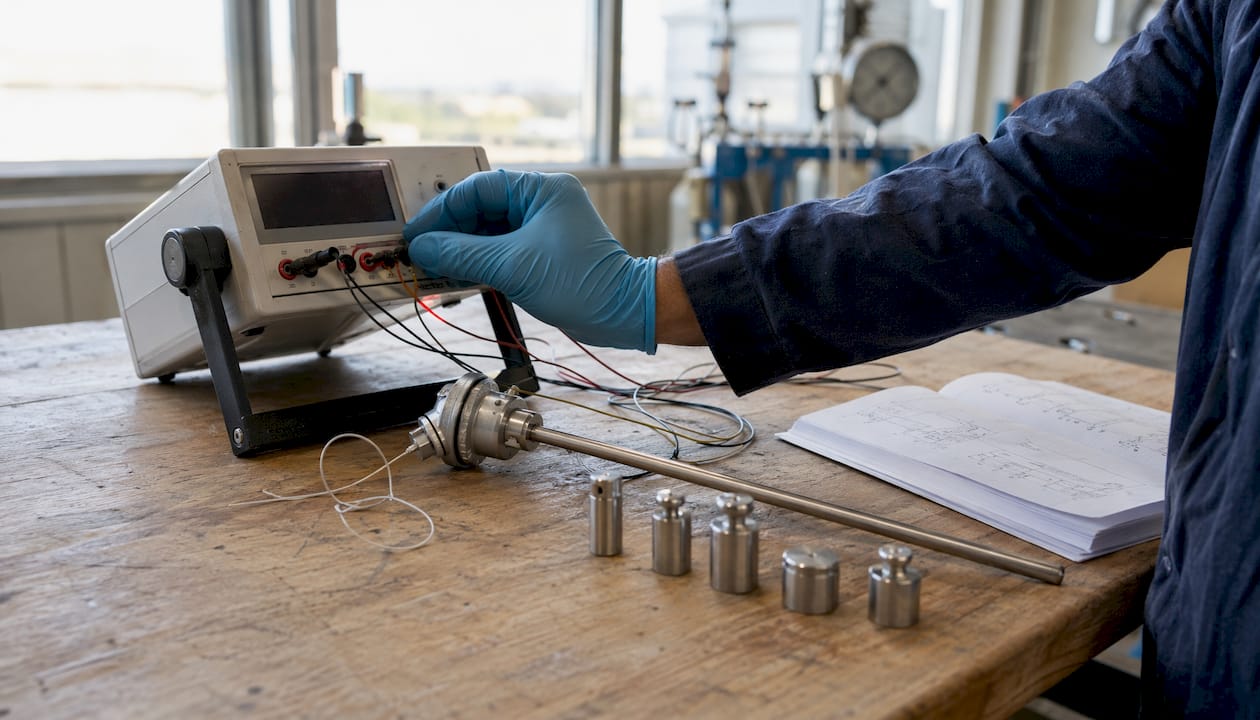
RTDs measure temperature through the predictable rise in electrical resistance of a pure metal, almost always platinum. They offer high accuracy and linearity up to 600°C, which makes them the preferred choice in laboratory and process control settings. The trade-off: they need external excitation current and more complex signal conditioning than a thermocouple.
Analog thermometer ICs integrate a temperature-sensing element and signal conditioning on a single chip, outputting a voltage or current proportional to temperature. They are easy to use but generally limited to moderate temperature ranges.
Digital thermometer ICs go a step further by including an on-chip analog-to-digital converter, delivering a calibrated reading over a digital bus. Digital sensors provide high accuracy with a simplified design, though they typically measure ambient or board temperature. Monitoring a specific remote component requires an external diode sensor interfaced with a dedicated IC.
Pro Tip: If your environment involves vibration, moisture, or temperatures above 300°C, a thermocouple is almost always the right starting point. For lab-grade accuracy between -200°C and 600°C with stable conditions, choose an RTD.
Where temperature sensors show up across industries
Temperature sensors appear in nearly every sector of modern technology, from the engine bay to the operating room.
- Automotive: Engine control units rely on coolant and exhaust temperature sensors to optimize fuel injection and prevent overheating. Battery management systems in electric vehicles monitor cell temperatures in real time to prevent thermal runaway.
- HVAC: Thermistors and RTDs regulate building climate by feeding temperature data to control systems, cutting energy waste and maintaining comfort.
- Industrial manufacturing: RTDs and thermocouples monitor process temperatures in chemical reactors, extruders, and furnaces, where a few degrees off setpoint can mean a scrapped batch or a safety incident.
- Medical devices: Body temperature monitoring, blood analyzers, and incubators all depend on sensors with tight accuracy tolerances.
- Consumer electronics: Smartphones, laptops, and gaming consoles use on-chip digital sensors to throttle processors before they overheat.
- Aerospace: Sensors rated for cryogenic and high-radiation environments track temperatures across fuel systems and avionics.
- IoT and smart retail: Sensor technology in retail now covers refrigerated display cases, cold-chain logistics, and smart shelving, where real-time temperature data protects perishable inventory and flags equipment failures before they become costly.
Prominent temperature sensor products available in the US market
Two manufacturers stand out for breadth of portfolio and documented accuracy in the US market: Apogee Instruments and Texas Instruments.
| Product | Sensor type | Accuracy | Temperature range | Typical applications |
|---|---|---|---|---|
| Apogee Instruments PRT | Platinum RTD | High precision, multiple calibration options | Wide range, suitable for scientific use | Scientific research, industrial monitoring |
| Texas Instruments TMP117 | Digital IC | ±0.1°C | Not publicly listed per model | Medical, consumer electronics, IoT |
| Texas Instruments TMP112-Q1 | Digital IC, automotive-grade | High accuracy | Not publicly listed per model | Automotive battery and thermal management |
| Texas Instruments (analog/thermistor portfolio) | Analog IC, thermistor | Varies by part | Varies by part | Industrial, power delivery, embedded systems |
Apogee Instruments Platinum Resistance Thermometer (PRT) is built for users who need scientific-grade results and flexibility in how the sensor is deployed. Apogee offers multiple probe styles and extensive calibration options, which matters when you are measuring soil temperature at depth, monitoring a growth chamber, or validating an industrial process. The platinum element gives stable, repeatable readings across a wide range.
Texas Instruments takes a different approach: integration over raw precision. The TMP117 hits ±0.1°C accuracy with an integrated EEPROM and I²C interface, making it a natural fit for medical wearables and IoT nodes where board space and power budget are tight. The TMP112-Q1 carries automotive-grade certification, designed for the thermal demands of battery management and powertrain monitoring. Texas Instruments also offers radiation-hardened variants for aerospace, rounding out a portfolio that covers almost every embedded application.

How to choose the right sensor for your application
Sensor selection is a balance of trade-offs, not a single-axis ranking. Work through these factors in order:
- Temperature range first: thermocouples handle extremes above 600°C where RTDs degrade; thermistors are ideal for narrow ranges near ambient.
- Accuracy and linearity: RTDs lead for precision; thermistors are highly sensitive but nonlinear; thermocouples are less accurate but rugged.
- Signal conditioning: thermocouples need cold-junction compensation; RTDs need excitation current; digital ICs need only a power supply and a bus connection.
- Environmental ruggedness: corrosive media, high vibration, or radiation exposure narrows your options quickly. Sheathed thermocouples and platinum RTDs handle harsh conditions; bare digital ICs do not.
- Sensor size and placement: good thermal contact is critical for contact sensors. Poor contact introduces lag and error. Non-contact infrared sensors sidestep this for moving or inaccessible targets, but require accurate emissivity settings for the surface being measured.
- Cost vs. reliability: thermistors are inexpensive and sensitive; RTDs cost more but hold calibration longer; thermocouples are cheap per unit but drift over time in high-temperature service.
Pro Tip: For HVAC and building automation, NTC thermistors offer the best sensitivity-to-cost ratio. For process control where the sensor may not be accessible for years, an RTD is worth the added cost because it holds accuracy far longer than a thermocouple under continuous heat.
Installation errors are a common source of measurement drift. Mount contact sensors with adequate thermal mass contact, avoid placing them near heat sources that are not part of the measurement target, and shield signal wires from electromagnetic interference, especially in industrial environments with variable-frequency drives.
Simlimsquareinsider: your resource for electronics and sensor products
The providers and products covered here represent the technical side of temperature sensing. If you are looking for a place to explore electronics products hands-on, compare options in person, and get advice from people who actually use this equipment, Simlimsquareinsider offers something the manufacturer pages cannot: a curated guide to one of Asia’s most active electronics retail destinations.

Simlimsquareinsider covers store directories, product categories, deals, and electronics retail trends across Sim Lim Square, Singapore’s go-to hub for tech hardware. Whether you are sourcing sensor modules, embedded development boards, or the test equipment to validate your temperature measurement setup, the platform helps you find the right vendor and the right price. Visit Simlimsquareinsider to connect with agents who can point you toward the specific components you need.
Key Takeaways
Choosing the right temperature sensor comes down to matching the sensor’s operating principle and accuracy to the specific demands of your application, environment, and budget.
| Point | Details |
|---|---|
| Five core sensor types | Thermistors, thermocouples, RTDs, analog ICs, and digital ICs cover nearly every application. |
| RTDs lead on accuracy | RTDs offer high accuracy and linearity up to 600°C but require external excitation and calibration. |
| Digital ICs simplify design | Texas Instruments’ TMP117 achieves ±0.1°C accuracy with a simple I²C interface, ideal for embedded and medical use. |
| Installation affects accuracy | Good thermal contact and proper placement are critical; poor contact introduces lag and measurement error. |
| Simlimsquareinsider | Offers a curated guide to electronics retail at Sim Lim Square, helping you source sensor components and development hardware in person. |
FAQ
What are the five most common types of temperature sensors?
The five most common types are thermistors, thermocouples, RTDs, analog thermometer ICs, and digital thermometer ICs, covering consumer, automotive, and industrial applications.
What is the most accurate type of temperature sensor?
RTDs, particularly platinum-based models, deliver the highest accuracy and linearity for most industrial and scientific applications. Digital ICs like the Texas Instruments TMP117 reach ±0.1°C, making them competitive for embedded and medical use.
What devices have temperature sensors?
Automotive engines, HVAC systems, smartphones, laptops, medical devices, industrial process controllers, and aerospace systems all use temperature sensors for thermal management and safety monitoring.
How many types of temperature sensors are there?
The five primary categories cover most use cases, but within each category there are dozens of subtypes. Thermocouples alone come in multiple standardized alloy combinations (J, K, T, E, and others), each suited to a different temperature range and environment.