

What is a tech community? A guide for Singapore enthusiasts
TL;DR:
- Singapore’s tech communities encompass diverse formats, from hardware meetups to industry bodies and consumer forums, all fostering learning and connection. These communities offer structured, repeatable events and feedback loops that produce real professional and personal value, unlike passive online groups. Physical spaces like Sim Lim Square exemplify how community knowledge translates into tangible experiences and informed decision-making.
Tech communities are not just Telegram groups where strangers swap memes about the latest smartphone release. In Singapore, they span monthly hardware meetups where engineers prototype new devices, formal industry associations connecting semiconductors to government policy, global developer chapters hosting hands-on workshops, and consumer forums that shape real purchasing decisions. If you’ve ever felt like the local tech scene is fragmented or hard to access, the truth is that Singapore’s ecosystem is richer and more structured than most people realize. This guide breaks down what tech communities actually are, what forms they take here, and how you can extract genuine value from them.
Table of Contents
- Defining tech community: Formats, functions, and value
- Key types of tech communities in Singapore
- How tech communities drive engagement and real-world impact
- How to engage with Singapore’s tech communities
- Why ‘tech community’ is misunderstood and how to find real value
- Explore Sim Lim Square and connect with Singapore’s tech community
- Frequently asked questions
Key Takeaways
| Point | Details |
|---|---|
| More than online chat | Tech communities in Singapore are active networks with meetups, industry bodies, and forums—not just chat rooms. |
| Multiple community types | Local tech communities include developer groups, industry organizations, and consumer-facing portals. |
| Engagement creates value | Practical activities and feedback loops drive real-world benefits for professionals and consumers alike. |
| Easy to join and connect | Anyone can get involved via events, forums, or retail spaces like Sim Lim Square. |
| Look for value, not status | Prioritize communities with real value exchange and participation opportunities over identity-only groups. |
Defining tech community: Formats, functions, and value
The word “community” gets used loosely, so let’s anchor it. A tech community is a group of people who share an interest in technology and come together to learn and connect, typically through events, workshops, and both in-person and online interactions. That definition sounds broad because it is. The key phrase is “come together to learn and connect.” Passive scrolling through a subreddit does not qualify.
What separates genuinely valuable tech communities from noise is structure and intention. Good technical communities are not just chat rooms or identity-based spaces. They produce real value when they have repeatable formats, professional relevance, and mechanisms for actual knowledge exchange. Think about the difference between a WhatsApp group that occasionally shares news links versus a monthly workshop where participants demo projects and receive structured feedback. The latter creates lasting professional and personal value.
Here is a quick comparison of common community formats:
| Format | Engagement level | Value type | Longevity |
|---|---|---|---|
| Online chat/forum | Low to medium | Information sharing | Variable |
| Monthly meetup | Medium to high | Skill building, networking | High |
| Working group | High | Problem-solving, output | High |
| Industry body | Medium | Policy, standards, advocacy | Very high |
| Developer chapter | Medium to high | Workshops, projects | High |
Beyond format, the functions matter enormously. Tech communities serve several practical roles:
- Learning acceleration: Peers teach you faster than textbooks, especially for hands-on fields like hardware prototyping or software development.
- Professional visibility: Presenting at a meetup or contributing to a forum thread builds credibility in your field.
- Market intelligence: Communities surface trends that media covers weeks later, giving members an information edge.
- Access and opportunities: Job leads, collaborations, and mentorships flow through communities far more organically than through job boards.
- Consumer guidance: For shoppers and enthusiasts, forums and review groups cut through marketing noise with real user data.
You can also see how these trends connect to the broader evolution covered in our tech retail trends Singapore guide, where consumer behavior and community knowledge are increasingly shaping how people shop for electronics.
Pro Tip: When evaluating a new tech community, look for two things: repeatable event formats (monthly, quarterly) and evidence of feedback loops where participants influence what happens next. Those are the clearest signals that the community produces real value rather than just occupying space.
Key types of tech communities in Singapore
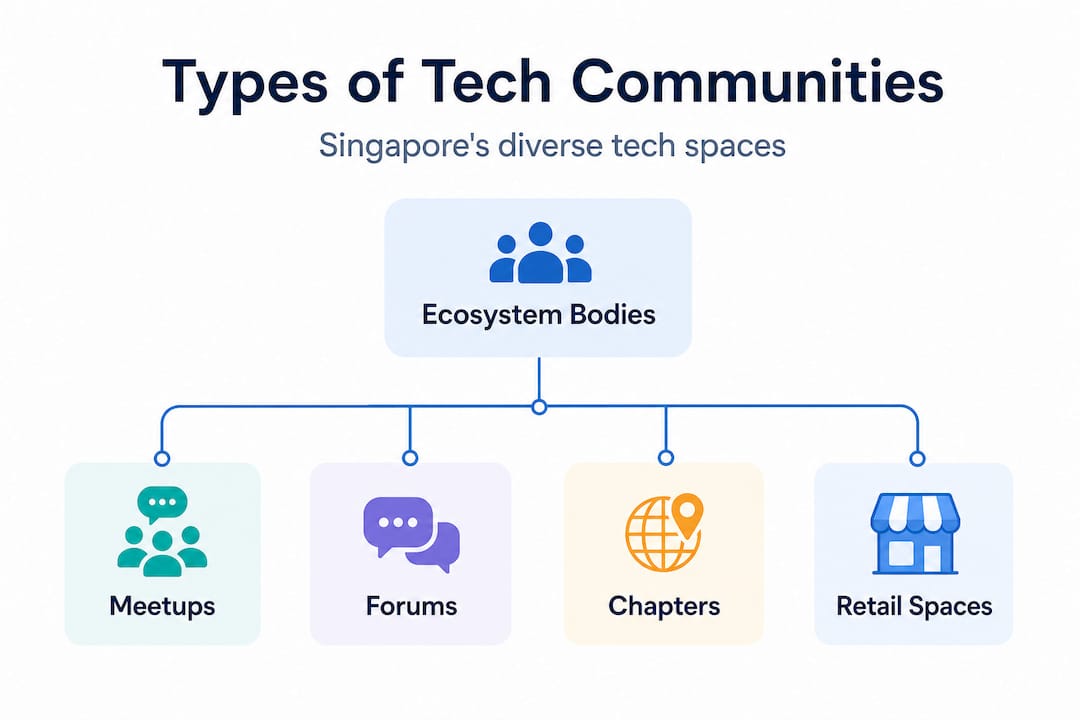
Singapore’s tech community landscape is surprisingly diverse. Once you look beyond mainstream social media, you find a well-developed ecosystem organized around different audiences and purposes.
Hardware developer meetups
Hackware is a monthly meetup for hardware developers and enthusiasts to share hardware hacks, developments, and build genuine community. This is not a casual coffee chat. Attendees demo real projects, from custom PCB designs to embedded systems builds. The format keeps people accountable and creative. If you’re building something physical or experimenting with microcontrollers and sensors, this is one of the most practical communities you can join in Singapore.
Formal industry and ecosystem bodies
At a more institutional level, the SSIA describes itself as the unified voice of Singapore’s semiconductor ecosystem, bringing together industry, academia, and government to foster collective impact. This type of community works at the policy and standards level. If you work in semiconductor manufacturing, chip design, or related supply chain fields, the SSIA is not just a networking club. It shapes the regulatory and business environment you operate in. Ignoring it means being absent from conversations that directly affect your career.
Developer program chapters
GDG Singapore is an independent Google Developer Group chapter with community events and nearly 5,000 members on its listing page. That number matters because it signals critical mass. Events attract a wide skill range, from absolute beginners to senior engineers, making it accessible regardless of your current level. Developer chapters like GDG also tend to organize structured content: talks, codelabs, and hackathons tied to specific technology stacks.
Consumer and media-led forums
Not all tech communities are developer-facing. HardwareZone.com.sg is a tech-centric portal and online community for tech enthusiasts and consumers, featuring product reviews, buying advice, and active user forums. For shoppers trying to decide between two laptops or hunting for the best deal on a graphics card, this type of community delivers practical, peer-validated information that no marketing brochure can replicate.
Here is a summary of these community types:
| Community type | Example | Event frequency | Best for |
|---|---|---|---|
| Hardware meetup | Hackware | Monthly | Makers, engineers, hobbyists |
| Industry body | SSIA | Ongoing/quarterly | Professionals, academics |
| Developer chapter | GDG Singapore | Regular workshops | Developers, learners |
| Consumer forum | HardwareZone | Always-on online | Shoppers, enthusiasts |
For those particularly interested in hardware shopping and gadget hunting, the best gadget shops Sim Lim Square guide connects neatly with the consumer community angle, helping you apply forum wisdom in a real retail setting.
Singapore’s tech community options at a glance:
- Monthly hardware meetups for makers and prototypers
- Semiconductor and tech industry associations
- Global developer chapters with local chapters in Singapore
- Consumer forums with product reviews and buying guides
- Retail community events and in-store demonstrations
- Academic and government-linked innovation hubs
How tech communities drive engagement and real-world impact
Looking at these examples, let’s examine the real impact these communities make on professionals and consumers.
The mistake most people make is treating tech communities as one-directional, a place to consume information passively. The genuine value emerges when participation becomes bidirectional through reciprocal value exchange and active communication rather than transactional use. When you contribute a project demo, write a forum review, or ask a detailed question in a working group, you trigger responses that improve your thinking and build your reputation simultaneously.
Here is how engagement typically works in a functional tech community:
- Entry point: Attend an event, join a forum, or sign up for a mailing list. This is low-commitment and reversible.
- Observation phase: Watch how discussions unfold, identify the active contributors, and absorb the community’s norms and vocabulary.
- First contribution: Ask a specific question, share a resource, or post a short review. Specificity matters more than length here.
- Feedback loop: Receive responses, corrections, or endorsements. This is where learning acceleration kicks in.
- Deeper involvement: Volunteer to present, join a working group, or take on a coordination role. This is where professional visibility grows significantly.
- Co-creation: Help shape events, contribute content, or collaborate on projects. At this level, you’re a community builder, not just a member.
This progression is not linear for everyone. Some people jump from entry point to co-creation quickly if they have relevant expertise to share. Others stay in the observation and contribution phases for months, and that is perfectly valid.
“The real impact of tech communities is not in the event or forum itself. It is in the feedback loop that forms between participants over time.”
For consumers specifically, the impact is more immediate. Following forum threads about electronics helps buyers avoid overpriced products, identify reliable repair services, and discover deals before they become mainstream knowledge. We cover this advantage in detail in our guide on electronics malls edge Singapore and for shoppers actively hunting discounts, our top tech deals Sim Lim Square resource translates community intelligence into direct savings.
Pro Tip: Seek out community events that explicitly invite feedback and audience participation rather than just passive attendance. Q&A sessions, open demos, and collaborative workshops signal a community that wants to grow with its members, not just impress them.
How to engage with Singapore’s tech communities
Once you see the value, here’s how you can get involved and benefit from Singapore’s tech community.
Getting started feels harder than it actually is. Most people overthink the entry point. Here is a practical breakdown of where to begin:
Where to start based on your interest:
- Hardware makers and engineers: Start with Hackware for monthly project demonstrations and community building
- Industry professionals and academics: Explore SSIA membership or event attendance for sector-wide networking
- Developers and programmers: Join GDG Singapore for workshops, codelabs, and structured learning events
- Shoppers and enthusiasts: Register on HardwareZone forums to access peer reviews and buying advice
- Retail-focused explorers: Visit Sim Lim Square and its surrounding retail ecosystem to see community knowledge applied in person
Step-by-step for first-timers:
- Pick one platform: Do not try to join everything simultaneously. Choose the format that matches your primary interest, online forum, monthly meetup, or industry association.
- Create a profile: Even for in-person groups, having an online presence associated with your community identity makes follow-up connections easier.
- Attend one event or read 10 threads: Get a feel for the tone and content quality before committing time or money.
- Introduce yourself: A brief, specific introduction (“I work in embedded systems and I’m interested in low-power Bluetooth implementations”) gets far better responses than a generic hello.
- Ask one specific question or share one useful resource: This is your first contribution. Keep it targeted and relevant.
- Follow up: Reply to people who responded to you. Relationships in communities are built through follow-through, not initial contact.
- Visit physical retail spaces: Connecting online knowledge to in-store experience is genuinely valuable. Knowing a product’s community reputation before you handle it in a shop changes how you evaluate it.
For those interested in the physical side of Singapore’s tech ecosystem, our guide on physical tech stores Singapore explains why in-store experience still matters, and if your device needs attention, our Sim Lim Square electronics repairs guide helps you navigate the repair services available in the mall.
Why ‘tech community’ is misunderstood and how to find real value
Here is the uncomfortable reality: most people who say they are “part of a tech community” are really just subscribed to a mailing list or lurking in a Telegram group. That is not community. That is a media channel with a lowercase “c.”
The confusion comes from branding. Organizations use the word “community” because it sounds warm and collaborative. But a logo, a Slack workspace, and occasional announcements do not constitute a community any more than a bus stop constitutes a neighborhood. The key distinction is between identity-only spaces, essentially a logo and a chat, and mechanisms that produce repeatable, content-rich value exchange through working groups, practical meetups, and genuine feedback loops.
Singapore is actually well-positioned here. The groups we’ve discussed, Hackware, SSIA, GDG Singapore, and HardwareZone, each offer more than branding. They have structures that produce consistent output: monthly events, working groups, standardized forums, and organized review categories. The question is not whether these communities exist. The question is whether you are engaging with them in a way that creates real benefit for you.
“A community that does not change how you think or what you know is just a notification subscription.”
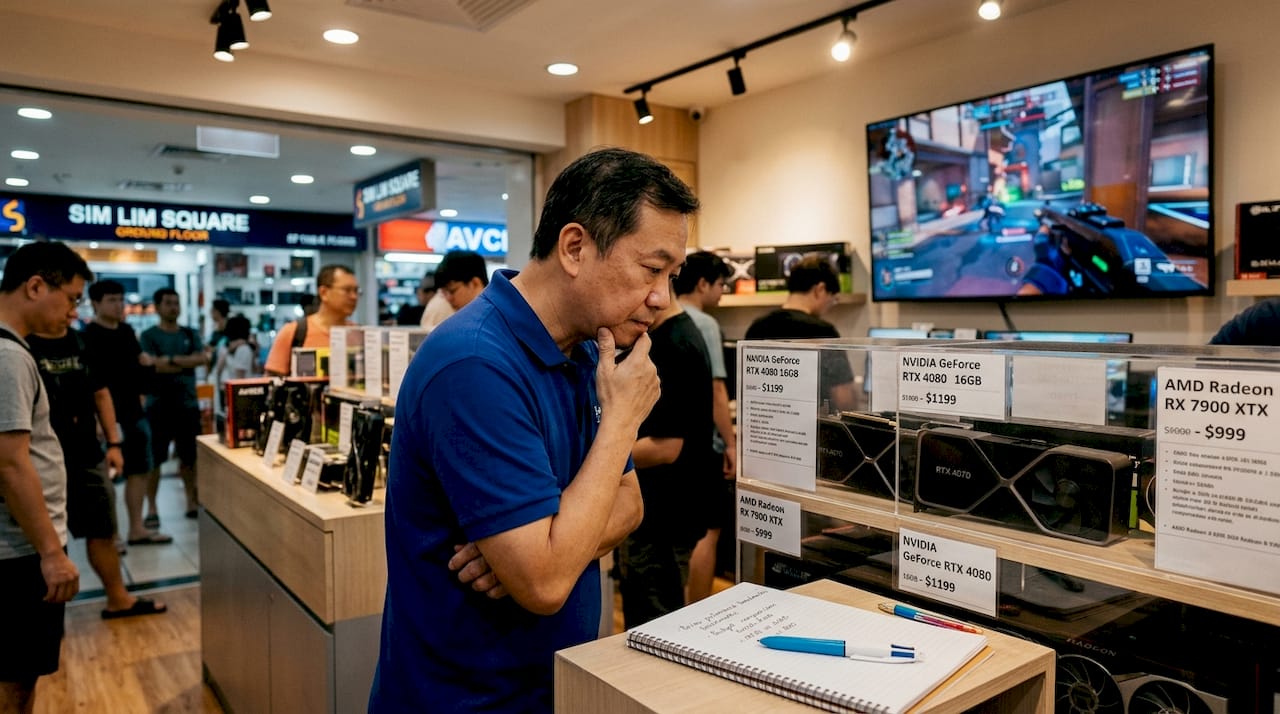
The store types at Sim Lim Square illustrate this principle well in the retail context. Walking through Sim Lim Square with zero community knowledge means you evaluate products in isolation. Walking through with forum research, peer recommendations, and an understanding of what different store types specialize in means every buying decision is informed, competitive, and far less likely to result in buyer’s remorse.
Our strong view at Sim Lim Square Insider: prioritize communities that are clearly invested in your growth and actively seek your input. If a community only pushes content at you and never asks what you need, it is a newsletter, not a community.
Explore Sim Lim Square and connect with Singapore’s tech community
Singapore’s tech community does not exist only online or in corporate conference rooms. It comes to life in physical spaces where enthusiasts, professionals, and shoppers converge, test products, compare notes, and make informed decisions together.
Sim Lim Square is one of those spaces. It is where community knowledge meets real products, where forum research translates into hands-on evaluation, and where the broader ecosystem of Singapore’s tech culture becomes tangible. Sim Lim Square Insider helps you navigate this environment with shop directories, curated buying guides, deal alerts, and a Sim Lim Square tech video tour that lets you explore the mall before you even arrive. Whether you’re a first-time visitor or a regular, our platform connects you to the retail community that powers Singapore’s tech scene.
Frequently asked questions
What types of tech communities exist in Singapore?
Singapore hosts hardware developer meetups like Hackware, formal industry bodies like SSIA, global developer chapters like GDG Singapore, and consumer-focused online forums, giving enthusiasts and professionals multiple distinct entry points.
How can I join a tech community in Singapore?
You can attend monthly events like Hackware, sign up for HardwareZone forums for consumer-focused discussions, or connect with industry associations like SSIA for professional-level engagement.
Are tech communities only for developers and professionals?
No. Singapore’s tech communities include consumer forums, hobbyist meetups, and retail-focused spaces where students, shoppers, and curious learners are equally welcome, not just technical professionals.
What do tech communities offer beyond networking?
They offer practical workshops, peer-reviewed product advice, collaborative projects, and structured feedback channels. Good technical communities generate repeatable value through formats that go well beyond casual networking.
Can tech retail and consumer spaces be considered part of Singapore’s tech community?
Yes. Retail environments and consumer-facing platforms like HardwareZone and physical destinations like Sim Lim Square serve as practical extensions of Singapore’s broader tech community, connecting buyers, enthusiasts, and professionals in shared spaces.
Recommended
- Tech retail in Singapore: Trends, experiences, and smart shopping – Sim Lim Square Insider
- Why physical tech stores still matter for Singapore shoppers – Sim Lim Square Insider
- Why compare tech retailers in Singapore for smart shopping – Sim Lim Square Insider
- How electronics malls give you a real edge in Singapore – Sim Lim Square Insider